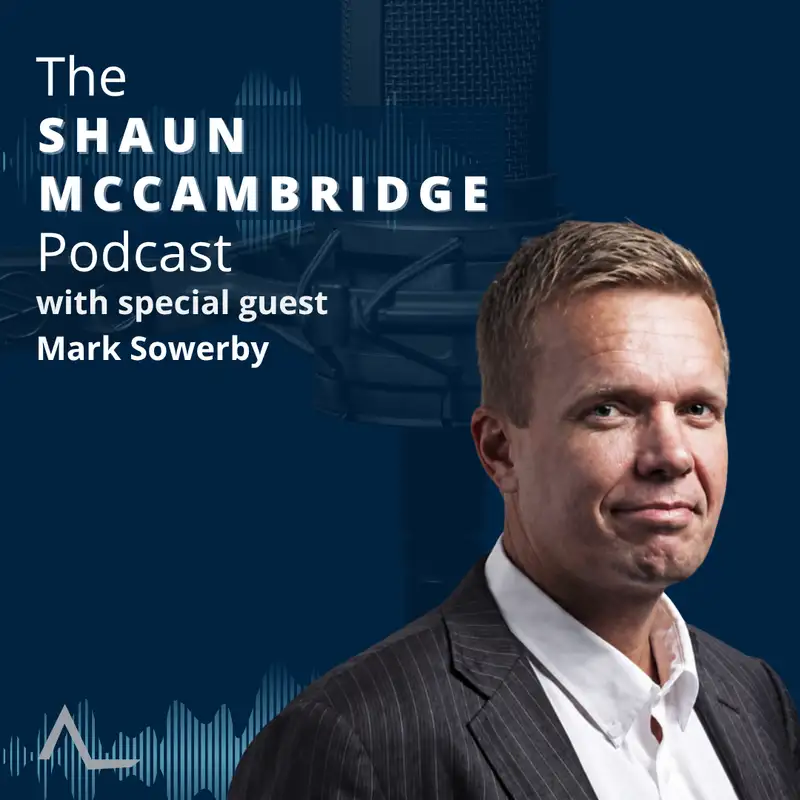
Don’t Be Prey! Blue Sky. Rock Bottom. Oceans Seven. The Mark Sowerby Story.
?Hi guys, I'm Sean McCambridge. For over 20 years, I've been inquisitive, learning and experimenting with different ways to leverage our greatest asset, our minds, to work for us rather than against us. Join me as I engage with these inspirational guests to provide you knowledge and insights to help you achieve more. This show is sponsored by Stellar Recruitment and inspired by our company purpose and why, which is inspiring growth and changing lives. Thanks very much for tuning in So Mark, thanks for joining us here today, mate. Yeah, sure. Awesome to catch up. It's been a while, so really looking forward to having a bit of a chat and sort of exploring what you've been up to. It's been a remarkable story. I think we started our respective businesses similar time- Yeah ... 2006, and I remember your humble little abode down there above the- Port Office the Port Office Hotel. Yeah. It was like a, a rabbit warren. And then obviously going to that, uh, beautiful building that you went into with the amphitheater, and it was... and the library, and it was staggering. And, and watching the business go from strength to strength and, you know, ultimately becoming a, a billion-dollar plus market cap, which is extraordinary. In a relatively short space of time, I think when you listed roughly 33 mil market cap. But maybe sort of take us back before all that. You know, I think there's a driving force behind every company that's successful, and obviously there's plenty of really intelligent, successful people supporting you on that journey. But talk to us what come before Bluesky. Where did that sort of hunger and drive to achieve something and do something great come from? I'm not sure that those drives were there. It's not really sort of a founder story with a great vision that- Mm ... wanted to achieve anything at all. It was more I really just wanted to work for myself. Mm. And I enjoyed building businesses or building things, and so it seemed like starting a little private equity company would be the way to do that. I was 35, so had had enough experience to know the things that I thought I was good at, and then trying to shape a life for us where it was more fulfilling than just working for other people. And I've been lucky. I've been CEO of both those companies as a young guy, so you get to learn a lot doing that. I done like, you know... Tried to back... I had a terrible... I had an ag science degree, which was a bit of a waste of time, and then I did- ... the graduate diploma in applied finance and quite... That was more a trading degree then, and then did an MBA. And I really enjoyed sort of building a toolkit and then trying things out. And the boys were two and four- Mm ... so it seemed like a really good time for us to try- Mm ... and we wanted to be back near family. Yeah. And we wanted to live at the Gold Coast as a result. So there's not really a lot of business there, Shaun, so there's a lot of small businesses because you have to start your own business. Mm. So that's the way it played out. It was more circumstances and this sort of idea of shaping things- Mm ... than anything else. Mm. It wasn't until we sort of... The natural DNA started to come through and then, then we got this sort of- North Star from Josh Lerner at Harvard, who had told me how Blackstone was listing- Mm. That listing in the US and it was, I think it was November 2018 or something like that, and sorry, not, not, not that, tw- 2008. I'm that old. Mm. And that was coming, and we realized that there was an opportunity to build something- Mm ... that might fill that gap in an, this much smaller market. Yep. And so then that became a drive. Plus we got some really, really smart people in that were capable of taking us there. Yeah. And with, that's sort of what we did. Yeah. So growing up you weren't necessarily the person that needed to, you know, strive to win the most amount of rugby games or, you know, be the best in the class or, you know, you had your little side hustle as a kid. There wasn't- No, not ... inherent DNA that come before all that necessarily. No. I think in hindsight there was always an engine, but I went to a boarding school- Yeah ... and had six years there and, you know, I got beaten up pretty bad there early on. So I, you know, I remember deciding in year eight- Mm ... that I can't change this trajectory. I need to just survive this. And that was six years at supporting school on a farm. You know, you're living with the same 14 guys in your room until you're 11. And so I just literally made a decision to survive and just took one day at a time- Mm ... and got through. And then came to University of Queensland and went to Emmanuel College, and life just exploded. Mm. So many good people, fresh start, you know, it's so sporty and a lot of drinking culture- ... and all the good stuff that you have back then. And being around, I guess, a lot of like-minded people. Mm. And so, you know, your friends for life are often built there. I met Heidi there as well, so- Yeah ... she was at a different college, you know, and so it's becomes the thing that defines you. Mm. Got some confidence from that and decided that I, you know, finished my degree but didn't want to do anything with it, so thought I'd travel and try and work out what I want to do, and fell into commodity trading. Yeah. No, fantastic. So, you know, I'll just quote some of these stats because they're pretty remarkable. You start Blue Sky in '06, like we talked about. In '12, you list the company at a dollar a share with a market cap roughly around 33 mil, and within six years Blue Sky has gone from 33 mil to a company worth close to a bill, and I think it peaked at 1.2 bill, if I'm not wrong. You know, was there a moment where you thought, "Holy shit, we've just done this"? Like, it's a pretty meteoric rise. Well, it wasn't meteoric in the sense that- Like a lot of the tailwinds were there. When I left when it was about 600 million. Mm-hmm. So the team took it to, you know, 1.2 eventually as a market cap peak- Mm ... if you wanna call it that. And so they continued those tailwinds. Mm. There wasn't really ever that moment. It seemed pretty natural. Mm. I thought we had enough good ideas that were unique to give us the ability to deliver on the promises we'd made, and that continued to happen. And so I left in August 2016, so just a year after I swam the English Channel, and then, what? 18 months, 20 months later- Mm obviously the company was attacked in an activist short selling attack. Mm. And so things changed pretty quickly. But I think what we managed to do was we managed to not go backwards. Mm. So, you know, I think we were one of, if not the best performing compound stock during that period of time, but it wasn't because we were going up in a, such a big way. Like it was still at seven or eight bucks. It was from a dollar. Mm. We were probably cheap when we listed really, but that's what happens, and so not sure that there was ever any sense of achievement or anything else there. Mm-hmm. It was more that there was a lot more to go. Those companies could be around for a long, long time- Mm and I felt like this was a company that was gonna do that. There must have been some moments though, driving down the coast, I think in your Hilux, you drove a- Yeah, the, the- ... the Hilux from, from- ... blue Hilux. Yeah, yeah ... I remember the blue sky Hilux. There must have been some moments when you're driving away from, you know, maybe closing some of the deals or, you know, some of the talented people you had in that magical office. There must have been some moments just, you know, even if it was a, a little moment, I know you're a humble guy, just thinking, "Shit," you know, must have been pretty proud of what you're achieving at that point in time. Look, I've got to say, it never happened. Mm. I'm sorry. Like- Yeah. ... it's, it just never happened. I never felt that at all. Mm. Mm. And, you know, we kept the majority of our shares after we left- Mm ... 'cause we thought it would continue on and do good things. And see, one of the nice things about those sorts of businesses is you're creating a lot of jobs as well. Mm. So it feels like you're, you know, you're not a financial business. Yeah, yeah. You're really, you're really- Fairness, yeah ... investing in stuff and trying to find the next big thing, and I felt proud of the culture and the people that were there. I really, I really missed the people after I left more than I expected. But you know, our chairman had said to me understandably so, he said, "Look, you know, I want clear air. We want to have clear air. We don't want you meddling," and all those sort of things. Yeah. And I understand that, you know? Yeah. I was this dictator. Yeah. So that was, so that was a fair enough call. Yeah. And I gave him the clear air. Mm. And then they ended up where they ended up. Yeah. So let's just sort of talk about that. Obviously, the music stops, so you've poured your heart and soul into that, and you made sacrifice, commitments, all that sort of stuff to go on this journey, build this company, along with some of those other talented people, and then the music stops, right? So all of a sudden it's your name, your wealth, your reputation, decade of your life, you know, once those short sellers or the reports around- Mm the valuation sort of come out, and then the decline happened, right? So it was well documented. Sure was. And no doubt it must have been surreal but challenging at the same time because I think I remember you saying at the time, you know, you couldn't even watch a, a game of sport with your, your boys playing rugby without someone, tongue in cheek or otherwise, having a bit of a, a pot shot or, you know- a comment around what they're reading, you know, not knowing the facts. So as a proud person, must have been hard. So sort of talk us through the, you know, that phase when this was all playing out. There must have been moments where you just thought, "How is this happening?" So it was totally unexpected. The company was raising over $100 million at the time and was massively oversubscribed- Mm. and getting ready for its next wave of growth. I remember thinking that they were raising it too cheap a price. It was $11.50, and I- Mm. ... I sat with, uh, one of our bigger investors who was a professional investor, and I said, "This is too cheap." Mm. And then a few days later they were shorted. Yeah. Look, the activist short sellers, structurally activist short selling came into Australia the year before with an attack on a company called Quintis- Mm. which was a asset manager in, you know, sandalwood, you know, timber essentially. So an ag fund manager in many ways. Mm-hmm. And they'd gone down, same group, and so then, you know, Blue Sky got attacked next, and then after us was Rural Funds Management. Mm. Mm-hmm. So I'm sure there was this perception that the activist short sellers were gonna be finding all the bad guys, helping ASIC attack them- Mm. Mm ... and put all of these terrible people in jail- Mm ... and et cetera, et cetera. And what actually happened was, so they attacked three companies that looked the same, had the same characteristics- Mm ... with assets that are difficult to value- Yeah ... or more difficult to value- Mm ... at least by perception. And behind that came a, you know, pretty massive media and online campaign. Mm. So fake websites, fake Twitter bots. So you're getting attacked on every level. From a personal perspective, I was outside the tent, and the company made it very clear to me that- Mm ... I was outside the tent because this was, you know, it was all legal and everyone gets, goes into their, into their shell. And so I was outside, and so I had no control and had to watch as it all unfolded with no control and no influence. So that's all, that was an interesting learning, and so much uncertainty as well, and fear. Mm. But then as, over time, I suppose, you know, I could piece together what had happened and why. I'd rather save that for another, a bigger story one day. Yeah, for sure. But what I was sure of was that it was fabricated. Mm. I was sure of that. A whole bunch of different things happened after that, and of course, a year and a bit later, Oaktree owns it, takes it out, and all the elements of the company- Mm ... are still running, and they've all raised money since. You can't change those things. No. And I had no control over them, and neither did the people that were working there in many ways. Yeah. So sometimes when the pile-on's on- Mm ... so then you've got to play a really, really long game. Mm. But personally, I ended up in a place I never thought was possible for someone. That I thought I was resilient, and I thought, you know, and optimistic. I mean, you have to be a naturally optimistic person- Mm ... to start businesses and run them. That's right. Yep. And, you know, I thought I had a, you know, some intellect and- Mm ... and some self-awareness, and as it turns out, you know, within days I was spiraling down, losing weight, not eating, not sleeping. Mm. Mm. And you end up on various drugs to help you sleep and- Mm ... very much just trying to survive. I found myself on a bench at Burleigh Heads twice and thinking about swimming out. So, you know, I just couldn't believe what had been written. Mm. I couldn't believe that this story was still running, and I, I just thought, "I can't beat these people." Yeah. "I cannot win the day. They're too powerful. They're too good." Mm. But luckily, you know, like in all these things, Sean, I, I had some really important people around me. Mm. Uh, just a few that, you know, kept me I mean, it's about survival then. So you're really trying to just get through each day- Hmm ... and stop setting new lows. And then, of course, you know, that's where I suppose we flip into the swimming piece- Hmm ... is that Tim Denis, my English channel coach, popped over in- Hmm ... December 2019. So this is, you know, this is well and truly a year and a half- Hmm ... nearly two years after the attack, and he was just shocked at my condition- Mm-hmm physically and mentally. Mm-hmm. And spent a number of hours with me trying to convince me that I needed a purpose, and that I needed to get back swimming. So, you know, in that conversation, the winning line from Tim was, "I've never coached anyone to do the Ocean's Seven before. You know, why don't we do it together?" And so once I'd said yes to that, actually COVID hit soon after. Hmm. You know, so just- That's right ... just a few months later. So luckily, you know, then I had something to train for, not knowing when it was gonna open up. Yeah. And that gave me a couple of years to get fit enough and- Hmm ... healthy enough. Hmm. And so probably from that moment onwards, you know, then things started to slowly edge up, and people like Tim Brailsford of Bond reached out to me and said, "Look, how can I help you?" And, and I said, "Can I train in your beautiful pool and- Hmm. Hmm ... in your beautiful gym, please?" Yeah, yep. And he, he, he set that up for me. And so then I just got surrounded by, you know, great people at that pool. Hmm. Hmm. And so you're getting down in the morning, and you're getting the right sort of start to your day. Hmm. And it's two or three hour training sessions. So- Yeah ... you're coming out, you're eating, you're sleeping. Yep. And you sleep better. Hmm. So all these things sort of started to compound up from that moment. Yeah, yeah. And I still would have some terrible moments sometimes while swimming. But generally, you know, certainly heading in a more positive direction. And then Wil Wild, who was a great mate of mine from uni, who had been a banker and was now a barrister and then became a solicitor to run this case He understood what had happened to us better than anybody. Mm-hmm. So Will, Will just stayed strong. He just kept working. We kept collecting evidence. Mm-hmm. We kept looking at stuff, and then we watched as all of these people disappeared. Mm. You know, Glaucus shut their company down 50 days after the attack. Now, so if you ever want to signal that something's not right here- Mm-hmm but the way it was reported was that Simon and Garfunkel were splitting up to start, you know, do their solo careers. Mm-hmm. Yeah, sure. Like it was... You look at that and you go, "Okay, well, objectively, I understand what's happening here, so we just need to be patient." Mm. And so we have been. Yeah. So for the average punter at home, what are the short sellers, you know, the activists and that, what are they standing gain? You know, if you're at the pub describing, you know, to someone that not familiar with these sort of dynamics on it- Mm ... what are they standing gain? Well, lots of money. So what they do is they look for companies that they either think are frauds- Mm ... or have accounting anomalies or whatever you want to call it. Yeah, yeah. But companies that perhaps that... Well, certainly their share price is higher than what they believe- Yeah ... their real value is. That's the sort of founding principle. Yeah. And then in an activist short, they're coming in, you know, pretty aggressively- Mm ... to expose those issues, whatever they are. Mm-hmm. And then they have sold the stock. Mm-hmm. So they borrow the stock from our institutional investors mostly. Mm-hmm. They pay rent for it literally. Mm-hmm. Mm-hmm. They sell the stock, and then they put the report out, and the share price typically falls. And- Yeah ... an academic in Yale told me the average share price fall was 42% on day one. Mm. So it's a really big payoff quickly- Mm ... with limited amount of balance sheet- Yeah ... about, with a bunch of risks associated with it. And so it's no different to putting out a report that's a bullish report. Mm. You've already bought the stock and the- Mm ... thing goes up and you think, "Hell, I'm a genius." But of course, if you know that report's coming out and you put the trade on, under the Australian law, that's insider trading And so these short positions were put on prior to the report. It's public knowledge they were up until five minutes before the report- Mm ... that they were still shorting it. And presumably the go button's hit- Mm ... and, um, the report drops and of course the share price starts to- Mm ... to tank. Mm. And it's self-fulfilling because everybody understands that if a activist short selling report comes out, A, there might be something wrong, and B, at the very least everyone get out and- Hedge it and, and let the company reset. Yep. And so obviously Blue Sky wasn't able to reset. You know, I can argue all day what the reasons why that might be- Mm ... but I don't need to for this- Yeah ... particular purpose. And so, so activist short selling is, you know, it's, it's an American phenomenon. It's come to Australia. Mm. Since we launched the class action, to my knowledge, there hasn't been a single- Mm ... activist short selling attack in Australia. Mm. And the reason for that, in my opinion, is because it's clearly illegal and, you know, if we win our case, our class action- Mm ... I don't think that we'll see activist short selling in that form in Australia again. Yeah. So just again for the, the layperson, your class action against them, you're, you're representing the shareholders that lost- Yeah ... wealth in this, uh, demise? Yeah, it sort of came to this point where I needed to make a choice. Like the evidence continued to mount up in our favor, and so I had to make a choice eventually. So we actually went after the Glaucus parties in America to try and get a deposition. I thought that was gonna be successful, then we got knocked back there on the basis essentially that two reasons. One is that the, the judge was convinced that I wouldn't go to court eventually anyway, and also that ASIC had signed off and said that Blue Sky had done nothing wrong, but it also said that Glaucus had done nothing wrong- Mm which is patently impossible. Somebody had- Mm ... to have done something. Mm. Mm. So anyway, we lost that. We had to come back to Australia, go to court, and we needed to find out who put all the trades on. Mm. So we went to court, took us quite a while and a bit of money, and we eventually got the trades and we discovered who that was. Mm. And they weren't on the radar. Mm. We didn't know they existed. And so suddenly at that point, I think, well, we knew then we had a seriously good case. Mm. But we actually got that information after we launched our first class action- Mm ... which was a lot broader. Mm. And so that meant that we had to make some changes to our, our case and really focus on the insider trading aspects. So I launched the class action on behalf of all shareholders, but ultimately couldn't escape This sense that a terrible wrong was done- Mm. -to the shareholders of Blue Sky- Mm. -and to all the people that work there, all the people that had supported us, and that the courts would be a way to get some compensation, but also some awareness and some independent test of what we were saying. Yeah. And I think that's playing out just fine. It's, uh, been a really interesting journey with ASIC. Mm. So there was a Senate inquiry- Mm. -into ASIC a couple years ago. Mm. And one of the questions was on Blue Sky. Mm. It's question forty-two. Mm. And essentially what it says is that there were three core allegations against the company- Mm. -which was around valuations, AUM and exorbitant fees. Mm. And the S- ASIC report says that none of those things were true, but they didn't tell us that. And what also became clear is that they'd exonerated or decided not to, you know, the way they express it is they decided not to pursue anything- Mm. -Blue Sky in November two thousand and eighteen, but didn't tell the company or the market that until May. And that is a really interesting anomaly for the group that is meant to be- Mm. -providing market disclosure. So we felt that there was something wrong with the way ASIC had managed all of that. And so you wonder, how can it be that all of the documents we get are completely blacked out? How can it be... We actually provided ASIC with a whole bunch of evidence of insider trading, and they came back to us and said, "We're not gonna do anything with it. It's too late. Can't be bothered," and a whole bunch of other things. Told us why short selling was good. And so we just kept digging, you know. And recently we discovered that the chairman of ASIC had been on the board of the short seller prior to us being attacked. And when I say the board, that's not true, actually. When-- On the advisory council- Mm. -of that company. Mm. Now, there are thousands of hedge funds in the world, and at the very least, it seems to me that there needs to be an investigation by ASIC into the insider trading. Mm. And there needs to be an investigation into ASIC into its own behaviors. Mm. And not just around Blue Sky- Mm. -but around other companies that were shorted and ASIC's role in that. You know, I, I find it extraordinary that... And we've written to them. Mm. We've written to the treasurer, we've written to the finance ministers- Mm ... and we've provided that information. Because what was really interesting in our court case was that the two of the short sellers have sought privilege against self-incrimination on the inside trading. Meaning? Meaning? What does that mean? It's like pleading the Fifth. So in other words- And why would you plead the Fifth? You would plead the Fifth so you don't have to put any evidence down that might incriminate you- Mm ... for those particular questions. Now, if I reckon if that was me- Mm ... I reckon it would've been back page or front page news. Mm. Mm. But it's been crickets. Yeah. And so you, you go, "Oh, wow, this is such an interesting planet that we're on right now." So there's a long way to go- Mm ... for us to close this out. You know, I'm really hopeful, obviously, that we can win our class action and get something back for shareholders, but I think as importantly, lock away the things that actually happened. Mm. But at this stage, no one's reporting on that story or covering it. Mm. Mm. And that's fine, you know, and they're not things that I can control. Mm. So, you know, you talk about sitting down there on the bench at Burleigh. Mm. You're contemplating swimming out to the horizon. Something stops you. Then you sort of find your way with support, your coach and whatnot, to find a new purpose, take on the challenge of swimming. Prior to all this, you'd done the English Channel, which is a remarkable feat. I remember sort of talking to you at the time and thinking, "Geez, what an amazing thing to do." So that, that was the precursor. Then you sort of went into this sort of, I guess, spiral went naturally, you know, mental health challenge, all the rest, but then you found your way out. You found this purpose, you found this challenge, and then you go to swim the Seven Oceans or the Seven Great Oceans. So talk to us about what that is. You know, there's different physical challenges that one can take on. Yeah, sure. Just tell us what that is, the brand of the Seven Oceans, and how would you equate it to other physical challenges that someone might take on if they're someone inclined? Yeah. Someone did some research on th- that point recently and said to me that the two hardest challenges on the planet are the 14 peaks but without oxygen, and- How many people have done that roughly? It's less than 50. Yeah. And same with, uh, Ocean Seven- Mm-hmm ... which is less than 50. So they're the top two. It did rank the, the one without oxygen as number one based on number of deaths. Yeah. Okay. So I think that's probably fair enough. That's a good metric. Yeah. So the seven are, so the English Channel, I'll do them in order that I did them. Yep. So English Channel, which is, you know, well-known. The next in it for me ended up being the Molokai Channel. Mm. So it's Molokai to O'ahu, which is the one they paddle. It was a, for me, a night swim. So you leave at 5:30 in the afternoon from Molokai. It's 45 kilometers. It's overnight, no shark cage, 700 meters deep in the, you know, there's marine life everywhere. And what, what are those sharks? Are they the keyhole sharks or? The cookiecutter sharks and- The cookiecutter sharks. Yeah ... yeah, but lots of... Yeah, they've got everything there. Like, it's the sharkiest place on the planet probably. Mm. And at night. So you're swimming, and then you've got a Shark Shields next to you on the kayak. Sure. So they help. I could actually feel them turning away from me- Yeah in the middle of the night. So that's getting them on the, you know, on the nose, and then they're turning away. So that's good. It's designed to keep the sniffers away. Mm. If something's coming hard, well, it's just coming hard. Yeah, gotcha. So then you land on Oahu the next morning if everything goes well. Then you've got, you know, the Catalina Channel, so Catalina Island to San Pedro, which is basically LA. Mm. That's a great white breeding ground, so one of Tim's swimmers got attacked by a juvenile great white there last September, October, which is 32 Ks, but it's not cold. Mm. But it's a night swim. Mm. So you get in at 10 o'clock at night. There's something- And, and night because of the conditions? Yeah, yeah. It's not favorable to swim under those conditions. Yeah, you just don't wanna be swimming into the, the wind. Yeah. It's very- The chop of the wind ... predictable weather there in LA. So, and then it, the swell comes up and all those things, so it's safer with a tired swimmer. It's not cold though, just a bit sharky. Then the Gibraltar Strait, which is the easiest, so from Tarifa to Morocco. Uh, it's sort of 15, 16 Ks. Mm. Uh, and you get to swim that with three other people, which was just a joy. And the North Channel, so Donaghadee, Northern Ireland- Mm ... to Portpatrick in Scotland. Same distance as the English Channel, but colder and with lion's mane jellyfish. It was a disgusting swim. Yeah. And the Cook Strait. Yep. So for me that was South Island to North Island. Mm. Which, you know, everyone in New Zealand just goes, "That's just stupid." Oh, you need to- There's a lot of sharks out there, right? be mentally ill to go swimming it. Yeah. Yeah, yeah. And then the final one, which ironically is, you know, was the one that everyone had failed the year before except for one guy, um, was the Tsugaru Strait, which is from Honshu to Hokkaido- Mm ... in Japan. It has all the elements, but essentially the way it's designed is that you're meant to be dealing with your kryptonite twice. Mm. So if that's cold water, big sharks, jellyfish, distance, whatever it is, you've gotta deal with it more than once. And that in itself is a really, really interesting challenge because sometimes knowing how bad something is is worse than actually not knowing. And so going back to it again, you don't necessarily go back to it with a better toolkit. Yeah, yeah. You go back to it with a- Yeah, yeah, yeah ... with a knowledge of all- More aware. Yeah, that's right. Yeah, yeah ... the more aware and you go, "Oh my God." And then it's all, you know... And particularly with the North Channel, it's worse than you could ever expect. Yeah, unbelievable. So obviously you've been through some tough stuff, obviously the challenges in a corporate sense, and then obviously you go through, you know, what you did in, in that swimming context. And I mean, look, there's just not many people, like you say, there's less than 50 people that have sorta successfully concluded that. You know, uh, pretty remarkable. So what, what do you learn about yourself About your ability to withstand some of those challenges because, you know, in fairness to you, it could have been a different story. It could have been sitting on that park bench and swimming out and, you know, maybe ending your life, uh, or what I'm gathering and, and that would've been a tragedy brought on by some of the activities that we talk about today. So what do you learn about yourself through any tough times, and what's your message for people that are navigating tough challenges? You wanna be careful with the message. So it's what I learned was the capacity for suffering and pain was so much greater than I expected. Mm. And it's a bit like you sort of get fit for it. So a lot of the things that we feel like they're painful- Mm ... are not really that painful at all. Mm. They're just painful in the context of our limited experience with pain. Mm. You know, then you... Usually something goes wrong in some of them as well, and e- each of them you're, you know, you're getting to the start line, and the best place you can be in is that you're totally prepared, you got your team ready, you've done all the work. But knowing actually you've done the work, not- Mm your coach knowing you've done the work, but you personally knowing that how hard you pushed and that you're totally prepared, sort of brings on this Real sense of joy and discipline that you have been able to complete- Mm ... the preparation. Mm. So that's one part. Mm. And stay with it, because you can't get across these channels if you don't do the work. That's the beauty of them, is that there's sort of no- Yeah ... like do a half-ass sort of training session, and don't bother doing the cold acclimatization. You've gotta do all of those things to give yourself a chance to get across, and then you need the right team. I learned a lot about trust. Mm. Mm. So I love Tim Denyer. He's quite an extraordinary human being. Mm. And he tells me he's gonna write a book, which I think would be magnificent. Mm. I hope he does. He, he's quite special. And so Tim and I were doing Q&A together around the UK, and this- Mm. Mm ... someone asked us a question about trust, and Tim said, "Well, look, the unique thing that I had with Mark was that I trusted him completely, that he would never, ever get out of the water." Mm. "He'd never give up, and he would let me choose when he needed to get out, if he needed to get out." Mm. "And that would only be if I thought his life was in danger." Mm-hmm. "So Mark also trusted me." Mm. "If I told him he could keep going, he knew that I... He could keep going. He didn't second-guess me." And that- Yeah I think that margin for error compression allowed us to win a few particular moments that were really, really close. Mm. We discovered in one of those Q&As that at the nine-and-a-half-hour mark in the North Channel, I actually thought about getting out, and he thought about pulling me out. Yeah. And we got to within a sort of five-minute window. Yeah. And the lesson from that was always that, you know, you've gotta win those moments. Mm. And if you win those moments, like everyone thinks it runs like a spreadsheet- Mm ... and it sort of works out, but what you have to do is win really special moments. Yeah. And if you win those key moments more often than not, then you'll end up achieving your objectives. Yeah. I did learn a lot, you know... I mean, there's a line in the film which I think is really nice, 'cause all of that is unscripted and filmed as you go. Mm. Mm. And they had to make a story. Mm. And Heidi said something like, you know, "He's found himself again in a better version." You know, then that's what you're trying to do ultimately- Mm. Mm ... is be the best version of yourself that you can be. Mm. Mm. Mm. I do think that the training and the channel swims in a multi-year project like that allow you to explore that, and you have bad days. Mm. Mm. And then you have days, like the feeling of getting to the end of one of those- Mm ... and particularly to the end of the last one, uh, I mean, I just can't describe the joy. It's a deep sense of joy. It's personal. There's no one else there, right? Yeah. Like, there's no crowds. No, that's right. Yeah. There's no crowds. Yeah. Yeah. So it's just you and the people that are closest to you. Yeah. You know, these are moments that you just can't buy. Mm. So you have to manufacture in a modern world. Mm. What was the longest swim you did? Ironically, it was the English Channel. Yeah. So in terms of time, so I did 14 hours and 24 minutes there. It was really rough. Mm. But I got really lucky in Molokai that the waves sort of turned around behind me a bit. Mm. 'Cause I'm not very fast. Mm. And I did 14 hours, 23. And then the next I think is... I mean, I have never thought about that, but the next would be the North Channel. Mm. Which was 12 hours, 12 minutes I think. Sure. And that was by far the worst. Mm. But even Molokai, quite special- Mm ... in the sense of, you know, how challenging they are. Yeah. All of them have different problems. So you complete the Ocean's Seven, remarkable lineup of swims. No mean feat. Probably some moments along the way where you sort of thought maybe you weren't gonna get there. That's pretty extraordinary, right? You know, you've got this training and nutrition and preparation, and then completion of these seven swims. So what does daily life look like after completing, you know, that remarkable sort of set of swims? Yeah. So what I learned along the way was... I mean, I suppose what, you know, when you think about what you're really trying to achieve, and the first one of those in particular was the English Channel. And what I was trying to understand was, I mean, maybe this is a guy thing- Mm but I still think it's a human thing. Mm. Is deep down, when it really got hard- Mm ... could I find it in me to finish the job and suffer through it and get it done? And the satisfaction I got out of the English Channel from knowing in that particular circumstance, on that day, that I was able to do it was so rewarding. But then what I didn't understand was that I learned a lot- Mm ... and I didn't apply it particularly well. I didn't apply the things that I learned to my daily life- Mm ... like I should've. Mm. And in fact, I do think that in hindsight there was some hubris and other things that came with achieving that, as opposed to the opposite- Mm which is what it should've been. What the Ocean's Seven does, 'cause it's so long, it breaks you down. Mm. The training breaks you down, then the swims themselves always present you with something, and often multiple things that are different. Yeah. And then you always feel different on different days. Mm. So each of them, in its own way, stripped me bare further. Mm. And particularly the North Channel, which sort of got to the point where the suffering was so bad, it literally felt like I was looking into my own soul. Mm-hmm. Like, there was nothing left to look at. I'd run out of reasons to be there. Mm. The pain was excruciating. Oh. I was freezing cold- Mm ... uh, and hypothermic. Uh, and Tim was keeping me just in the game. Then when you find a way through that, and then the next two as well, and get it done, what I've found is that... So if you take a distribution curve of your behaviors- Mm ... I don't seem to have anything in the middle anymore. I'm either totally settled and composed, or- On the extreme or really emotional. Mm. So it's like I've been stripped bare, and all of the stuff that's made up in between is gone. Mm. But I can find my way to this place. Mm. And in this place happens to me, but I'm comfortable with it. Mm. And it's not emotional in the sense of being crazy or anger or anything like that. Mm. It's just actually feeling the emotion of a particular moment. And those moments are still raw. Mm. And so then what happens is, is that because you're different and because you're more settled and comfortable with yourself- Mm ... so it's about accepting yourself, it's like that ripples out to everyone around you and impacts them. And maybe as much as anything else, Sean, it's the negative things you used to do are more often than not gone- Mm ... or certainly mitigated. Mm. And so that's gone You take away that volatility, and so everything in your life resonates differently- Hmm ... as a result of it. And so that means now at 55, you know, Heidi and I have decided to get back out on the edge again- Hmm because we're really comfortable out there. Hmm. We think that we're getting too comfortable with our life, and so, you know, we're literally selling everything up and- Hmm ... following the film and writing a book, and maybe Don't Be Prey To, but not as a documentary, as a real movie. Mm-hmm. And to really bring this story to life. So that's a, that was the unexpected benefit- Hmm ... and that for sure is life-changing. For sure. Yeah. Now, I think you made some good points in, in just reflecting on your answers there. I think as a male, maybe as a female, I certainly had that. You know, like you asked that question, when it really matters, and if I'm put to the test, have I got what it takes to endure? You know, and I think you explore that in different ways, right? You explored that with your swimming. I know for myself, you know, doing a couple of boxing fights, there was plenty of moments early on where I thought, "What am I doing?" It would be so easy to come up with an excuse to bail on this, but I, I said to myself, "I want to answer the question, have I got the courage to get in the ring?" Have you got the courage- Yeah ... to do your swims? And I think when you answer that question, as you have, as I have in a, in nowhere near to the same scale, I think there's a sense of peace going, "I've got nothing left to prove. I've answered that question." To yourself, though. Yeah, correct. To yourself. That's, that's- And that was the beauty of the swims. You know, what I was really, the really background driver of the swims, the why, was I needed to find my courage again- Hmm ... to do what I knew I had to do- Hmm ... that was gonna risk everything, put me back into the public limelight again, all of the things that I shouldn't be doing- Hmm ... against all the advice that I'd received. And so I needed to rebuild my courage for that, and that took time. But once I found it, and you know, the moment that I said to the legal team, "Let's go," I immediately started to feel better. Mm-hmm. Immediately. Yeah. Immediately. You know, and then in the end, things are playing out the way they are, so let's see where that lands. Yeah. Now, I love your, uh, reflection on comfort as well. I think as human beings, we want to be comfortable, right? You know, inherently, we want to be comfortable. I was at MIT doing a course one day and, and there was a bit of a round table small chat conversation, and this guy, he's from San Diego, he goes, Alex, he goes, "Just want to go around the room and just, I want everyone just to recite the last time you were out of your comfort zone." And to be honest, it really struck me. At that point in time, I'd been living a very comfortable life. Yeah. You know, like when you really reflect on it, when was the last time- Wow ... I was really out of my comfort zone? And invariably, it was sort of somewhat similar. And to me, that was just a signal or, or a jab in the face going, "You're living too comfortably. You need to step out to the edge-" Yeah ... like you say, from time to time and just live life a little bit, you know what I mean? Yes. It doesn't mean you've always got to succeed or fail, but just that willingness to step outside your comfort zone, and ultimately is when you do that, you tend to grow. It was just a lightning bolt moment going, "Jesus, I've just been living way too comfortably." But you're happier too. So when, you know, when I would go to the Croatian swim camps- Mm ... you had 30 people that were all, you know, outside their comfort zone. Mm. Mm. On the edge, cold water swimming- Yeah ... and all the things, the training that comes with that. Most of them just ordinary human beings. Mm. And but some lucky army guys and Olympians- Mm ... and other people that are there, but they're still outside their comfort zone- Yeah ... 'cause this is new, and they're by far the happiest people- Mm ... and the most grounded- Mm ... and the wisest. Yeah. I, I was really inspired by all of them, and that tribe is, you know, sort of restored my faith in humanity and were great to talk to around the things that I was thinking about doing and their thoughts. So you know, like wisdom's hard to find. Mm. But it turns out it's out on the edge. That's it. That's it. Yeah. So no, it's a great answer, so, uh, great insights and, and thanks for sharing that, mate. What's your greatest achievement? Oh, it's the boys, for sure. Mm. So when we were getting attacked everywhere- Mm you know, like, I would go to things and- Mm ... Heidi and I decided that we were going to-- The boys are 13, 15, really young, and so we-- The school was magnificent. We just said, "Look- Mm ... let's just keep this from them as best we can- Mm ... and let them get on." So we went to all, all their games and did all the things we should do as parents- Yep to the point that they had no idea until someone said something to them. You have that moment with both of your boys- Mm. Mm ... at different times. That was really emotional and- Mm ... quite frankly, pretty awkward. And the impact on them, on their future, if, if I was to allow the story that's been told- Mm ... to appear to be true- Mm then that impacts them for the rest of their life. They'll be at a meeting somewhere and like, "Oh, you're Mark Selby's son." Mm. And so the story I told myself was that they would go to a meeting and then they'd go, "Oh, wow, you're Mark Selby's son." Change the narrative. So change the narrative. Correct the narrative. And so there's this great moment after I finish the Cigar? streets, the whole Ocean 7, and the boys have drawn and illustrated- Mm ... a picture for me with a note from each of them. Mm. You know, that's peak dad. Yeah. So- Yeah, yeah. But also the relationship with Heidi is obviously... You know, she's our foundation stone in the family- Mm and she sets the rules and standards- Yeah ... and we sort of try to aspire to be like her- Mm ... 'cause she was the one that had done a lot of stuff- Yeah ... before I decided to do the English Channel. So, and then, and our boys are inspired by her as well. For sure. So for us as a couple, you know, we absolutely, our relationship is stronger than it was- Mm as a result of getting through these terrible things. Mm. And she understood completely that I needed to take the risk and put the effort into seeking justice. And so she's been behind me with that through the noise as well, and so very fortunate. And then you end up with a tighter circle of friends- Mm that is deeper. And some of the people that you think are your friends are, are not. But also some of the people, to be fair, I've been a bit tough on that. To be fair- Mm ... if anything like that happens to you, quite often people don't know what to say or do, or they've got their own crap going on- Mm. True and they really don't realize that you're in that position. Mm. And so I needed to be more forgiving of people than I was- Mm ... but I was bitter with everyone and - Mm. Mm ... but I'm certainly, you know, certainly more circumspect now and, and judging too quickly on those things. Yeah. What does winning look like today for you? And just going beyond that a little bit, what would you hope... You know, your boys are growing up, they're forging their own path, doing some great stuff, as we talked about before. You know, if they're away in Whistler or in the UK playing rugby or whatever, and someone said, you know, uh, "Explain or describe your old man," what would you hope they say? So, you know. I don't know. I don't know. I, I think that's too presumptuous of me to... I, I, I don't wanna shape those things. I, I think- No ... that's, I understand the question, but I think I'll- No, no, no ... but, you know, so- But I mean, they had front row seats, right? They- Not really. They didn't see it, and they got front row seats at the swims. They, they must have seen you like they're seeing this vibrant dad probably coming in the door you know, maybe discussing elements of the day being, you know, mostly good for the best part, and then all of a sudden they're seeing this guy sort of start to, to wither, you know, under the pressure and the strain. So they, they have front row seats to that of- I think we did a really good job of making sure that they didn't get presented with that. Hmm. Yeah, okay. And to the point that when the boys got to watch the Don't Be Prey, the film- Yeah ... the documentary individually beforehand, that it was a shock to them. Yeah, they, they know he's doing some things tough, but, I mean, they've got kids. You know, they're teenage boys. Like, they've got plenty going on. Yeah, that's right. Yeah. So, you know, I think it's a bit too self-centered to- No ... you know. What I would say is it's more important for them when they're in particular situations to understand the difference between right and wrong. Hmm. And, you know, if I look back at the way... It wasn't a straight line. Like, you know, you do get fearful, you do wonder, but like, you know, like when you try, you get the breakthroughs. Mm-hmm. It's like starting a business. Mm-hmm. And I treated it like a business too. Mm. It wasn't a straight line and- Yeah ... but I understood completely that I was the natural owner. No one else was gonna do it. Mm. As the founder, I felt like I had an obligation, not just to the shareholders, but to the team that had been slaughtered in the press and accused of things that they had not done. Mm. And I felt I owed it to all of them to turn that into a net positive, 'cause I cannot s- unscramble the egg. No. There will always be stuff around that. But what I can do is turn this into a net positive. Now, how do you take the killing of a billion-dollar company and all the people in it, and their reputations and everything else, and it was vicious. Oh, brutal. And how do you take all of that, and the loss of shareholder wealth, and then the effect on the funds because no one's really running them properly, and all these things that happen, how do you take that into a net positive? It's gotta be big, right? Mm. Mm. So winning looks big. Mm. So winning to me, the class action is ideally just a starting point. So that is not everyone who was involved in this. Mm. Almost all of the names- Right ... I have them written down, and I'm, you know, just gonna as best I can, and I'm... You know, maybe one day I'll lose the, the rage, but, you know, we're eight years in and I'm still going pretty strong. Mm. Mm. But I wanna cross their names off. So there's lots of different ways that I can do that. Mm. But most importantly, I, you know, I've seen a lot of the things that they've done and said, and I think that they clearly wanna be famous. Mm. So my promise to them is I'm gonna make them famous. Mm. And then their wives, they're all guys, right? Mm. So their wives and their children- Mm ... and the people they work with can know who they really are. Mm. Mm. That for me is winning. Yeah. Well, you talk about purpose, right? You've been successful in business. You've done remarkable stuff, you know, swimming, and I guess this is a, a purpose to basically right the wrongs and out the behavior and the conduct, uh, of those that, uh, did what they did. And some of the benefits that come from that, firstly, is that everyone thinks they can get away with it until they can't. Mm. So let's just see how that goes. Mm. But also, when we left work, what we decided was we wouldn't do philanthropy. We would do what we called social good. So we took on Chief Entrepreneur, took on- Yeah Racing Queensland staff, other things that we did privately- Mm. Mm ... that were things that other people wouldn't do- Mm ... that we needed to catalyze or did things that were hard. This is hard, but already there are a bunch of people that don't know that their lives have been changed- Mm ... in the positive sense because they did not get attacked- Mm. Mm. True ... in an act of a short-selling attack. So who knows who's gonna be the next in the gun. Mm. So I think there's still a lot of good that you can do. For sure. I think the film itself has turned out extraordinarily better than I expected. So let's just talk... We've talked about that a couple times. We actually haven't talked about it. So talk to us about the film. How did it come about? Sure. What's going on with that? And then I think you mentioned before, there's potentially a, a book on the back end of that. Move to the US, whatever else. So yeah, just give us a bit of an insight- Sure ... the... I watched the documentary, amazing film, and really, really interesting and inspiring to watch, but give us a bit of an overview of what that's all about. Yeah, so when, when I was on the English channel, we were trying to raise a million dollars, and we got to about 700- Heads off. I forgot about that. Yeah, we hadn't... We got to about 700,000 and we hadn't- Yeah. And that was including me, like people giving me bonuses for getting across- ... which no one expected me to do. Yeah. And as we got closer, we realized that was all we were gonna get. Mm. And I, I actually gave up on the race in the sense that I just wanted to swim And get it done. Yeah. And so Jeff Sing, who ended up directing this, the whole film, offered for free to come over and film it to try and keep the race going and just to see what happened. Yeah. Yep. And in the end, it ended up quite dramatic at the end, and he did a little 41-minute documentary, which actually ended up being a great resource for all channel swimmers 'cause there was nothing. Mm. A little bit of iPhone footage. Yeah, yeah. So you could see how you get fed and see what hypothermia looks like. Yeah. And so we ended up raising another 700,000 off the back of that. And so when I went back to swimming, and it was the Molokai Channel, I, I didn't call Jeff. I was still, I think, you know, at that stage still feeling a lot of shame and- Mm ... and so didn't reach out to Jeff. I got a local Red Bull filming guy in, in Hawaii to film it. And so he filmed Molokai. He had a drone too, which was good. You know, drones were sort of getting around a bit by then. And after Molokai, I called Jeff and I said, "Hey look, can I come and see you?" So I went and saw him, and it was very emotional. And so he deci- said he would come and film Catalina But he said to me, he said, "Mark, swimming's so boring." He said, "I really don't wanna do it. I'll do it for you." Mm. "But this is not gonna go anywhere." Mm. And he films Catalina, and he's, "No one's gonna believe this." Mm. "Let's-- I'm gonna film them all." Mm. And so then we film them all, and Steven Sander, who'd won an Emmy and filmed Tim, my coach previously, he's an English guy, he joined the team, and those two guys made Don't Be Prey. Mm. We certainly didn't make it. Mm. And I think they've turned that into a beautiful movie. Mm. And so it's now being accepted into film festivals all over America, which is really cool. Yeah. 'Cause it was sort of built a bit for that market. Mm. There's a lot of Americans in it, a lot of other swimmers in it too. Yeah. Not just me. And so I think what we see every time people watch that is, there's a great line that my eldest son Lachie had, which described the movie, which I think is the best, which is ordinary people doing extraordinary things. And so, you know, with no talent and finding a way to do something- Mm uh, that changes theirs- True ... and others li- others' lives. And so the film, I think, takes you to a great place. Mm. And particularly if you've been through tough times. Now, the reality is, unfortunately, everyone's gonna have trauma in their life. That's true. And so getting ready for that or understanding how to deal with it or a toolkit, or even if you've been through it, seeing that there's still hope, I think this film does a beautiful job. The swimming is just a metaphor. It's just a platform. It's not- Yeah ... really a swimming movie. If you're a swimmer, you'll love it, but you don't need to be a swimmer. Mm. You just need to be human. Definitely. Yeah. Uh, well, it's a remarkable story, a remarkable journey. No doubt there's more to come. So I look forward to watching that all play out. But I really appreciate you joining us here today, mate. It's a remarkable story, and, you know, credit to you for how you navigated it and you know what you've achieved. I, I forgot all about the, the money you raised for Starlight, you know, the million dollars plus or whatever it was. You know, the, the swim itself, you know, is just remarkable, and what you've been able to do with that. And I think also, you know, in a world where it seems like resilience is getting less common, you know, people seem to be getting less resilient in some regards. I think you're proof that we're capable as human beings of some pretty remarkable stuff if we're tested, when we're tested, and sort of you're a great example of how to sort of navigate some of those challenges and not just, you know, minor challenges, pretty big challenges. So I think it's inspirational stuff, mate. So I really appreciate you coming here today to discuss that and, and share that journey. Thanks, Shaun. Thanks so much for tuning in. Means the world to me. Uh, if you got something of value out of the podcast, I'd love you to pay it forward and share it with anyone that might benefit. Thanks again for tuning in